
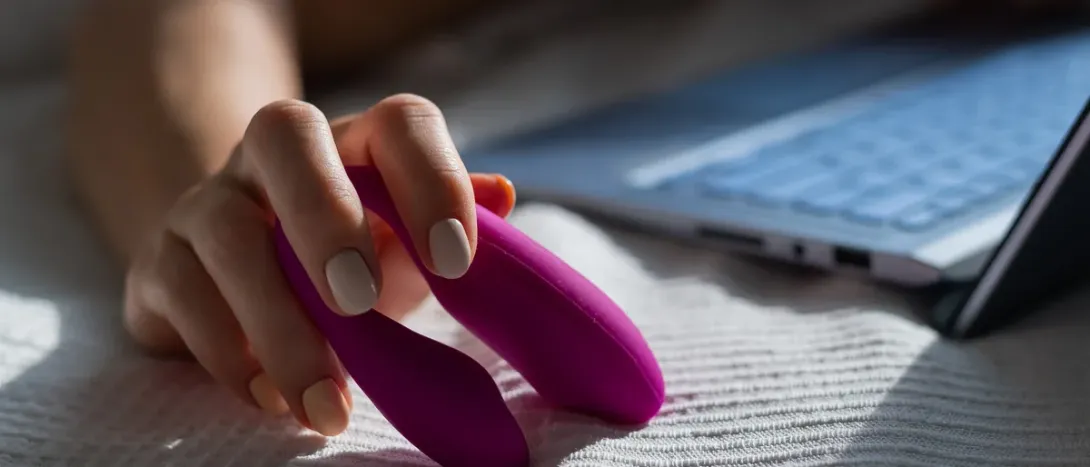
A toy in your own hand does exactly what you tell it. A toy in your partner's hand is the same toy, with the same settings, but it lands differently. What changes is not its power. It is that someone else is now adjusting it to your body as your body changes, and you no longer have to run it. This article explains what that adds, how a partner can read you while holding it, the common mistake when you go quiet, and why keeping the toy in your own hand is just as valid.
Your own hand is more precise, and that stays true
Alone, you know where the toy should sit, how hard to press and when to ease off, and you correct it before you have even noticed you are doing it. No partner can match that from the outside. Their hand will be a beat late, a little off the spot, a little unsure. That is not a flaw to fix; it is simply what happens when the controls move to someone who cannot feel what you feel.
So a partner holding the toy is not a more accurate version of you. It is a different thing. In the clinical experience this article draws on, what it adds is not better settings but three things your own hand cannot give you:
- You stop running it. Your attention no longer has to sit on the toy, the angle and the button. It can go to the feeling itself.
- The changes come from outside. Your partner's rhythm is human. It shifts in ways you do not plan and cannot quite predict, and a toy alone never does that.
- You are being read. Someone is watching your body and answering it. For many women, that is the difference between "a toy was used on me" and "someone was paying attention to me". You are not being operated; you are being read by someone you want.
Research supports the general point that who you are with matters, not only what you do. In a study of more than two thousand women in the United States and Hungary, the kinds of activity during partnered sex were linked to how pleasurable orgasm was and how hard it was to reach, and relationship satisfaction played as large a role as the activities did (Rowland and Kolba, 2019). Using a vibrator with a partner is also common and is linked to positive sexual experiences (Herbenick and colleagues, 2010).
Different doors
Women do not all open through the same part of this. In the clinical experience this article draws on, three different doors come up again and again:
- Being filled and steadied. A partner holding something inside you still and steady while the outside does the work, so you can let go of the whole lower body.
- Not controlling where the peak comes from. Not knowing what the next change will be, so you stop steering toward the finish.
- Being closely read. Feeling each small shift in your breath or hips answered almost at once.
None of these is the correct one. You may have one, two, or none of them, and it can change from night to night.
What your partner can change
A toy in a partner's hand has more dials than the buttons on it. It helps if both of you know them:
- Where it sits. Right on the tip of the clitoris, on the hood above it, to one side, flat across the whole vulva, or at the vaginal opening. Moving it is often a bigger change than any button.
- How it rests. Barely touching, resting with its own weight, or pressed in. The same strength feels very different at each.
- Strength and rhythm. Two separate dials. When a feeling fades, the sameness is often the reason, not the strength (more: Strength and Rhythm Are Two Different Dials on Your Vibrator).
- On and off. Lifting the toy away for a moment and bringing it back.
- Anything inside. If a second toy or his fingers are inside you, the angle, the depth and whether it moves or stays still. Something inside usually goes in once you are well aroused, not before (more: Wet is not the same as ready: how arousal opens the vagina), and combining inside and outside tends to make the climb slower and fuller rather than faster (more: Inside and Outside Usually Make It Last Longer, Not Faster).
A place to start: your partner begins low and broad, on the hood or across the vulva rather than on the tip, and changes one thing at a time, then waits a few breaths before changing anything else. That way you can tell what the change did, and so can they. It is one way in, not the rule. Some women want it direct and strong from early on. Keep whatever feels best to you.
How a partner reads you
Your body answers each change before you say anything. These are signs that partners can learn to watch. They are common, not universal, and your own signs may be different.
Often means it is landing, keep going:
- Your breathing drops lower and slows, instead of staying high and quick.
- Your hips stop hunting for the toy and either move with it or go still.
- Your thighs stop bracing against it.
- Your face loses its effort and softens.
Often means it is too much right now:
- You flinch, or pull your hips away from the toy.
- Your breath catches, goes sharp, or you hold it.
- You reach down toward the toy or his hand.
- You say it tickles, stings, or feels irritating, or you start to go numb.
When it is too much, the first move is usually broader or lower, not more: off the tip and onto the hood or the side, flatter across the vulva, a lower setting. The tip of the clitoris is the part that overloads first (more: The Tip of Your Clitoris Needs a Buffer, Not More Power). If the area has gone numb, turning it up makes it worse; pause instead (more: When it goes numb: pause, don't turn it up).
Sounds help too, but they are easy to misread; what matters is how they change, not how loud they are (more: Her Sounds Tell You What Just Changed, Not How Good It Feels).
The common mistake when you go quiet
Sometimes, well into it, you go quiet. Your breath settles, you stop moving, you stop chasing. From the outside that can look as if the toy has stopped working. In the clinical experience this article draws on, a common mistake a partner makes at exactly this point is to press the toy harder or turn it up, which breaks the slow build that was just starting.
Quiet and still, with a soft face and deep breathing, often means the feeling has moved from the sharp spot to somewhere deeper. The move there is to hold steady: same place, same setting, same pace. A partner can check with one word ("good?") rather than by changing something. Real loss looks different: numbness, restlessness, a tense face, you adjusting the toy yourself. More on reading and holding this middle stretch: Inside and Outside Blend When One Is Loud and the Other Is Quiet.
Telling your partner without leaving the feeling
You do not have to give a speech. A few words do most of the work: "lighter", "wider", "lower", "stay there", "there". Or put your hand on your partner's wrist and hold it still, which says "exactly this, don't change it". If you want to show where to start, lay your hand over theirs on the toy and move it once the way you would (more: guiding a hand with yours). Then let go and let them take it from there.
If something is going wrong and you want to say so without ending the moment, see Saying "Not That" Keeps You in Your Body; Faking a Moan Takes You Out of It.
Handing it over by remote
With a remote-controlled toy, your partner holds the remote instead of the toy. Both your hands are free, and you can hold each other. The limit is that a remote only changes strength and pattern, not where the toy sits, so the reading still matters: your partner should be watching you, not the remote. Agree beforehand on a starting level and a highest level, and keep the remote in reach of your own hand too. Not seeing what is coming next is its own thing, covered in What a Blindfold Takes Away: Watching Yourself and Seeing What Comes Next and Strong Vibration Works Better Once You're Aroused: When to Bring a Toy Into Sex. Any toy like this is for private settings, at home or somewhere just as private, never in public.
A worn toy with a remote is one way to try this: it sits in your underwear against the clitoris and the vaginal opening without a hand holding it, and the remote lets your partner change the setting while both of you keep your hands free. Its vibration is strong, so start at the lowest setting.
When it turns into a performance
A partner holding the toy only adds something if they are really there. In the clinical experience this article draws on, what a partner brings depends on genuine interest and attention. Going through the motions adds nothing, and holding the toy on you while their mind is elsewhere can feel flat.
The same goes the other way. If you start acting more pleasure than you feel so your partner feels successful, or you endure a setting you do not like, or you both start measuring the night by whether you came or how big it was, the thing that made it worth handing over is gone. There is no scoreboard. Some nights are for being read, some are just pleasant, some go nowhere, and all of them count.
Your own hand is just as valid
None of this means a partner should hold the toy, or that it is the next level after using it alone. Some women describe loving it when a partner uses the toy on them. Others can come with their toy in their own hand but not when a partner holds it, and it has nothing to do with the partner. Both are ordinary.
Alone and together do different jobs. Alone, with full control and no one waiting, is often the easier place to learn what you like: where the toy should sit, what happens with something inside, how the middle stretch feels. Together is where someone else reads you. What you learn alone travels: research links a closer match between what women do alone and in partnered sex with orgasm coming more easily with a partner (Rowland and colleagues, 2019). You can keep the toy yourself while your partner kisses you or holds you. Handing it over and keeping it are both choices, and you can make a different one each night (more: using hands or a toy as the finish).
Safety and taking it back
- Agree before you start what is in and out: outside only or inside too, a strength limit, and a word or gesture that means stop.
- You can take the toy back at any time. Reaching for it, pushing the hand away or saying "stop" ends it at once, with no discussion needed then. Taking it back is not a verdict on your partner.
- Stop at pain, burning or stinging, numbness that does not pass after a pause, or any bleeding. If pain keeps coming back, see a doctor (more: Toys and your health: when to check with a doctor).
- Use lube on the toy and the skin it touches, so it glides instead of dragging (more: lube and silicone).
- Keep toys clean, and never move a toy from the anus to the vagina without washing it first (more: Toy Hygiene Is About the Gaps and What Moves Between Openings).
- Being held still is a separate step. If you want to combine handing over the toy with restraints, read Wrist Cuffs for Beginners: Being Held Still Takes Away Decisions first.
For the partner holding it
- Watch her, not the toy. Her breath, hips, thighs and face tell you what each change did.
- Start low and broad, and change one thing at a time.
- When she goes quiet and soft, hold steady. Do not turn it up to "get her back".
- When she flinches or pulls away, go broader or lower before you try anything stronger.
- When she says "there" or holds your wrist, change nothing.
- If she takes the toy back, let it go. That is the arrangement working, not failing.
What to take away
Handing a partner the toy does not make it stronger or more precise. It lets you stop running it, and lets someone read you and answer. For that to work, the partner starts low and broad, changes one thing at a time, watches your body, holds steady when you go quiet, and goes broader or lower when it gets too much. You guide with a word or a hand on the wrist, and you can take the toy back whenever you want. And if the toy works for you only in your own hand, or on some nights only, that is just as valid.